
What should a supermarket buyer specify?Define the product assortment and countdown, compare structures around the filled products, and quote the complete packing and delivery scope. Approve a filled sample, agree assembly responsibilities and confirm the retailer’s receiving requirements before mass production.
A Practical Procurement Guide to Packaging Design, Product Compatibility, Assembly, Cost Control and Retail-Ready Delivery
Advent calendars bring a seasonal product collection into one numbered package. For supermarket chains, a programme may combine beauty products, individually packaged food, coffee, tea or pet treats. The packaging brief needs to connect that assortment with the way the finished calendar will be stocked, displayed and delivered.
However, buying custom advent calendar boxes for a supermarket chain involves much more than choosing an attractive design. Retail buyers and procurement teams need to consider packaging structure, product compatibility, material selection, production costs, assembly requirements, transportation and delivery schedules.
This guide explains the key factors supermarket buyers should evaluate when sourcing custom advent calendar boxes, helping retail teams make informed purchasing decisions and avoid common packaging and supply chain problems.
1. Define Your Advent Calendar Concept and Target Products
Before requesting a quotation, buyers should determine what products will be included in the advent calendar.
Different product categories require different packaging structures and internal protection solutions.
Common advent calendar product categories include:
- Beauty & Cosmetics: Skincare samples, makeup products, perfumes, lipsticks and personal care items.
- Food & Confectionery: Chocolates, biscuits, sweets, jams and other individually packaged food products.
- Tea & Coffee: Tea bags, loose-leaf tea sachets, coffee capsules and instant coffee.
- Beverages & Spirits: Miniature bottles, sealed beverage containers and tasting collections.
- Pet Products: Individually packaged pet treats, biscuits, toys and accessories.
- Lifestyle & Accessories: Jewelry, small gifts, stationery and seasonal accessories.
The dimensions, weight, fragility and packaging condition of each product will influence the calendar box structure and internal insert design.
Procurement tip: Prepare a product list with the dimensions, weight and packaging condition of each item before finalizing the box design. This helps packaging manufacturers recommend a suitable structure and avoid unnecessary revisions during sampling.
For assortment planning, explore tea calendar packaging or pet Advent calendar packaging, then assess the sealed contents and required compartment sizes for your programme.
2. Choose the Right Advent Calendar Box Structure
The structure of an advent calendar box affects its appearance, usability, production cost and retail presentation.
For supermarket chains, the most suitable structure depends on the product assortment, target retail price, display requirements and number of compartments.
Common options include:
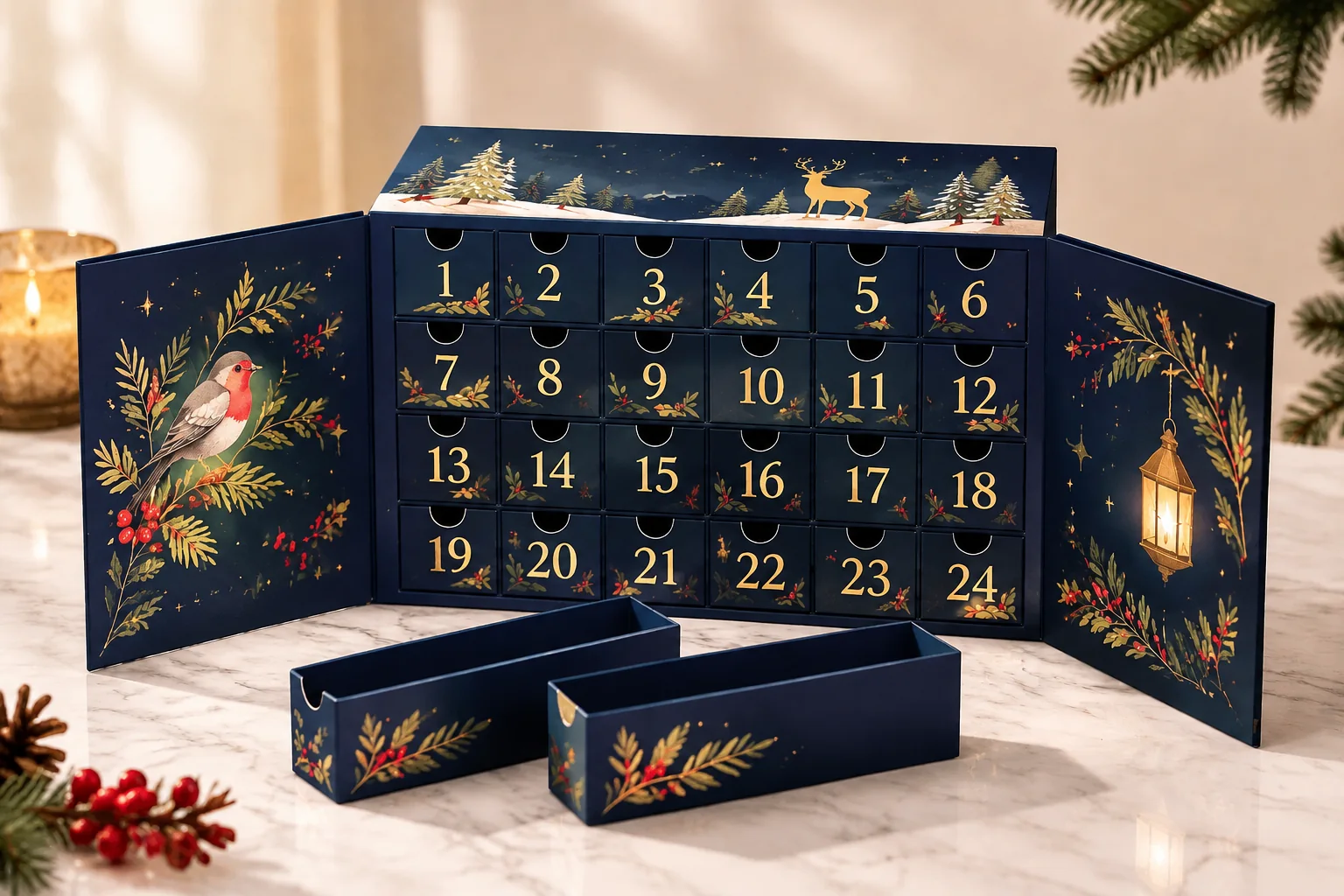
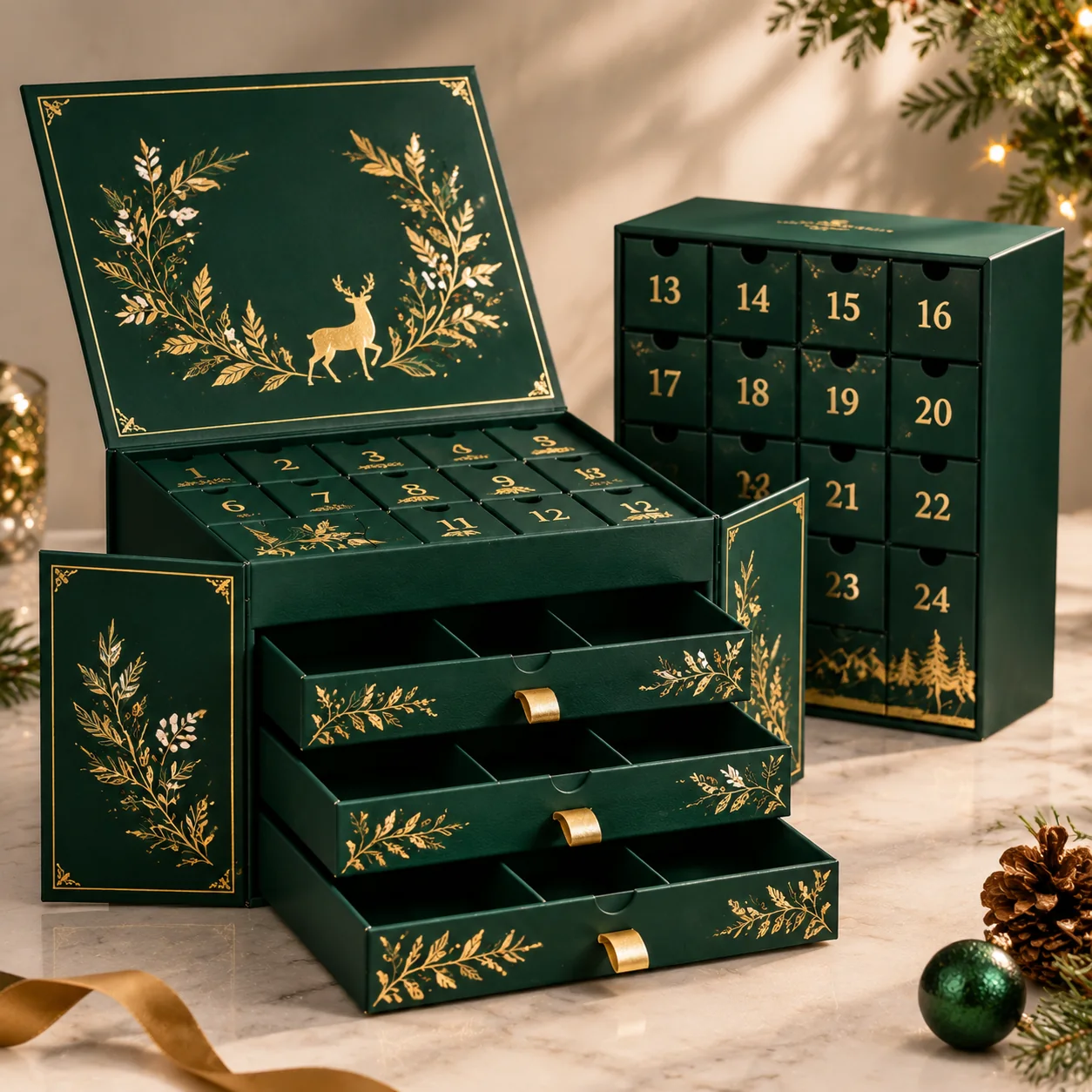
Drawer-Style Advent Calendar Boxes
Drawer-style calendars feature multiple pull-out compartments, making them suitable for beauty products, accessories, tea collections and small gifts.
They offer an organized presentation and allow different products to be arranged in individual compartments.
Door-Style Advent Calendar Boxes
Door-style calendars feature numbered opening doors, allowing consumers to discover one product each day.
They are suitable for chocolates, cosmetics, pet treats and other small packaged products.
Book-Style Advent Calendar Boxes
Book-style boxes open like a book and can accommodate multiple compartments, paper boxes or custom inserts.
They offer a practical balance between product organization, presentation and packaging structure.
Folding and Multi-Panel Advent Calendar Boxes
These structures can open from the center or expand into multiple panels, creating a larger presentation area.
They are suitable for seasonal collections that require a distinctive unboxing experience.
House-Shaped and Special-Shaped Advent Calendar Boxes
Custom-shaped calendars help retailers create recognizable seasonal displays and distinctive gift packaging.
They are particularly suitable for Christmas-themed collections and promotional retail programs.
When selecting a structure, buyers should evaluate not only its visual appearance but also its assembly complexity, storage efficiency and transportation requirements.
3. Select the Right Packaging Materials
Material selection is an important factor affecting packaging strength, appearance, production costs and transportation performance.
Common materials used in custom advent calendar boxes include:
Rigid Board Construction
Rigid board, commonly made with greyboard wrapped in printed paper, is suitable for premium advent calendar boxes.
Typical applications include beauty calendars, gift collections, premium tea boxes and luxury seasonal packaging.
Advantages include:
- Strong and stable construction.
- Premium appearance and tactile experience.
- Suitability for magnetic closures, hinged lids and drawer structures.
- Support for foil stamping, embossing and other decorative finishes.
Folding Carton Construction
Folding cartons made from paperboard are suitable for lightweight advent calendars and cost-conscious retail programs.
Advantages include:
- Lightweight construction.
- Efficient storage and transportation.
- Suitability for printed door-style calendars and blister packaging.
- Flexible printing and structural design options.
Corrugated Packaging Construction
Corrugated board can be used when additional structural support or transportation protection is required.
It can also be combined with printed paper to create retail-oriented packaging.
The final material specification should be determined according to product weight, box dimensions, structural requirements and the expected distribution environment.
4. Design the Internal Compartments According to Your Products
The internal structure is just as important as the outer box.
For supermarket buyers managing multiple products in one seasonal collection, every compartment needs to be designed according to the actual product dimensions and protection requirements.
Common internal solutions include:
- Paperboard inserts: Suitable for lightweight products and paper-wrapped items.
- Rigid board dividers: Suitable for organizing multiple compartments and supporting heavier items.
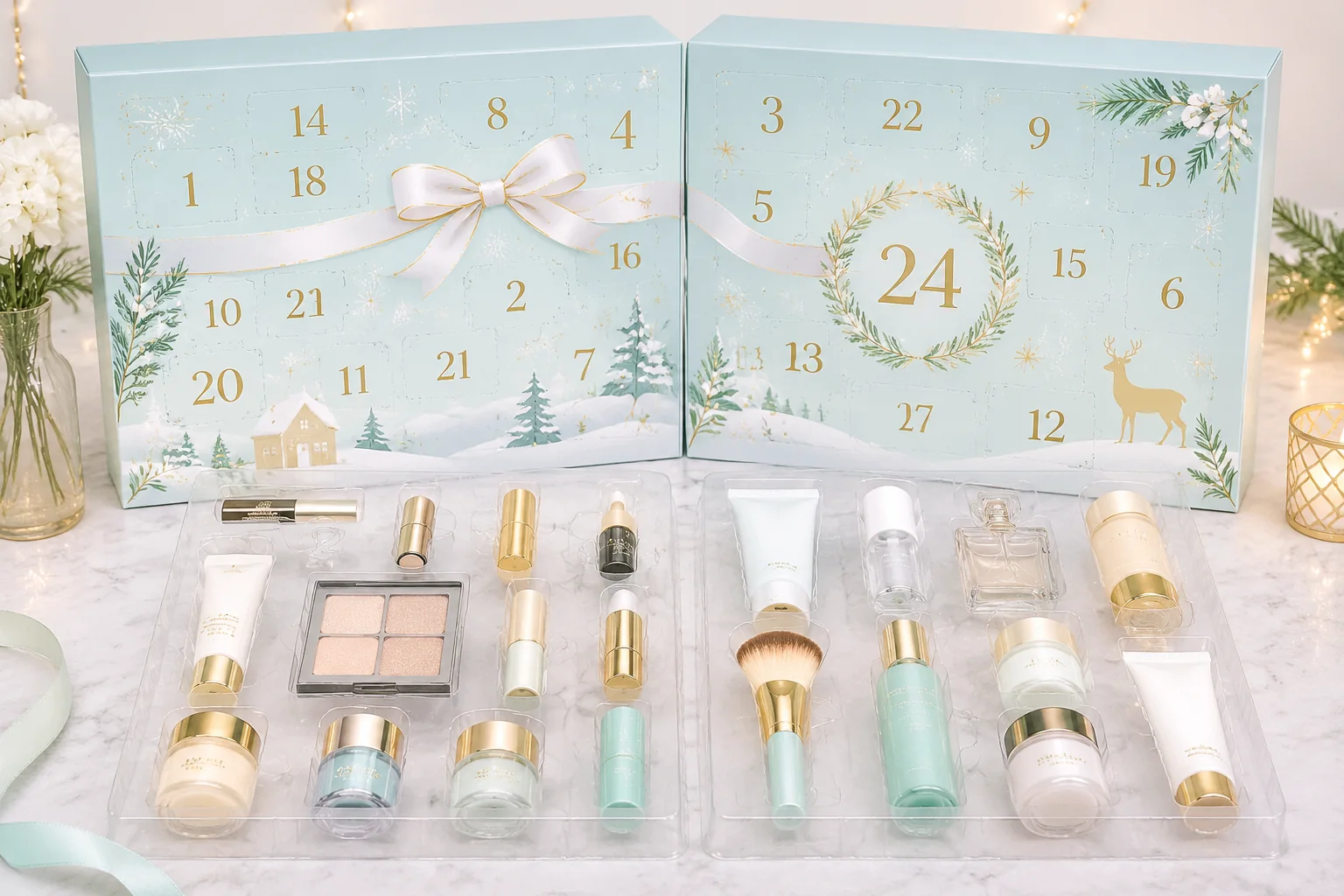
- PET blister trays: Suitable for products with specific shapes that require individual positioning.
- Foam inserts: Suitable for fragile items, glass bottles and products requiring additional cushioning.
- Custom paper trays: Suitable for paper-based packaging concepts and organized product presentation.
For example, a 24-day beauty calendar may require 24 individual compartments for different cosmetic products, while a coffee capsule calendar needs inserts that hold each capsule securely.
For food, tea and pet treat calendars, individual product packaging should also be considered.
The packaging manufacturer should confirm the compatibility between the product dimensions, internal insert and outer box before mass production.
5. Consider Food Contact and Product Protection Requirements
One of the most important considerations when purchasing advent calendar boxes is the distinction between the outer packaging and the packaging that directly contacts the product.
For supermarkets selling food, confectionery, tea or pet treats, buyers should clarify how each product is packaged inside the calendar.
For example:
- Chocolates may require individual food-grade wrappers.
- Tea bags may require sealed individual sachets.
- Pet treats should be individually sealed in suitable packaging.
- Jam jars should be properly sealed and secured inside protective inserts.
- Coffee capsules should be protected according to their original product packaging requirements.
A printed paperboard outer box or a standard PET insert should not automatically be considered food-contact compliant.
If any packaging component will directly contact food, the appropriate material specifications, compliance documentation and testing requirements must be confirmed for the intended market.
Important: Buyers should communicate the intended product-contact conditions to the packaging supplier before material selection and production.
6. Calculate the Total Procurement Cost
The unit price of an advent calendar box is influenced by several factors, not just the outer box dimensions.
Key cost components include:
- Outer box structure and materials.
- Number and complexity of internal compartments.
- Printing and decorative finishes.
- Internal trays, inserts and protective materials.
- Manual or automated assembly.
- Product loading and individual packaging requirements.
- Carton packing and transportation.
- Shipping destination and delivery arrangements.
For supermarket chains, purchasing decisions should consider the total landed cost rather than comparing the outer box quotation alone.
A more complex structure may require additional assembly labor, while a carefully optimized design may reduce packaging material consumption, storage space and transportation costs.
Buyers should request quotations based on clearly defined specifications to ensure that different suppliers are comparing the same packaging requirements.
7. Plan Assembly and Fulfillment Before Mass Production
Assembly is often one of the most challenging parts of large-volume advent calendar projects.
Unlike ordinary gift boxes, advent calendars may contain multiple compartments, trays, individually packaged products, promotional materials and different product combinations.
For supermarket chains, an efficient assembly plan is essential to ensure consistent product placement and timely seasonal delivery.
A professional packaging partner should be able to discuss the following:
- Whether the packaging will be delivered flat-packed or pre-assembled.
- Whether internal trays and compartments will be installed at the factory.
- Whether the customer's products need to be loaded into the calendar.
- Whether different product combinations require separate assembly instructions.
- Whether quality checks are performed during product loading and final packing.
- Whether finished calendars can be packed according to retail distribution requirements.
Confirm the Assembly Site and Scope
Agree where each stage will take place and who will supply the products, inserts and packing components. Product loading, labelling, final inspection and carton packing should each have a named responsibility. Confirm the manufacturing and assembly sites during quoting; do not assume that a box-production location also handles every filling or fulfilment service.
For the detailed SKU map, loading sequence and handover checks, use the existing assembly-planning guide rather than treating the outer-box quote as an assembly agreement.

8. Evaluate Transportation, Storage and Retail Display Requirements
For large supermarket orders, transportation and storage costs can significantly affect the overall project budget.
Buyers should consider the following questions before confirming packaging specifications:
Can the boxes be shipped flat-packed?
Some folding carton structures can be shipped flat to reduce transportation volume. Rigid calendar boxes may require different shipping arrangements.
How many finished boxes fit into each master carton?
The carton quantity should be calculated according to the finished box dimensions, protective packing requirements and transportation limitations.
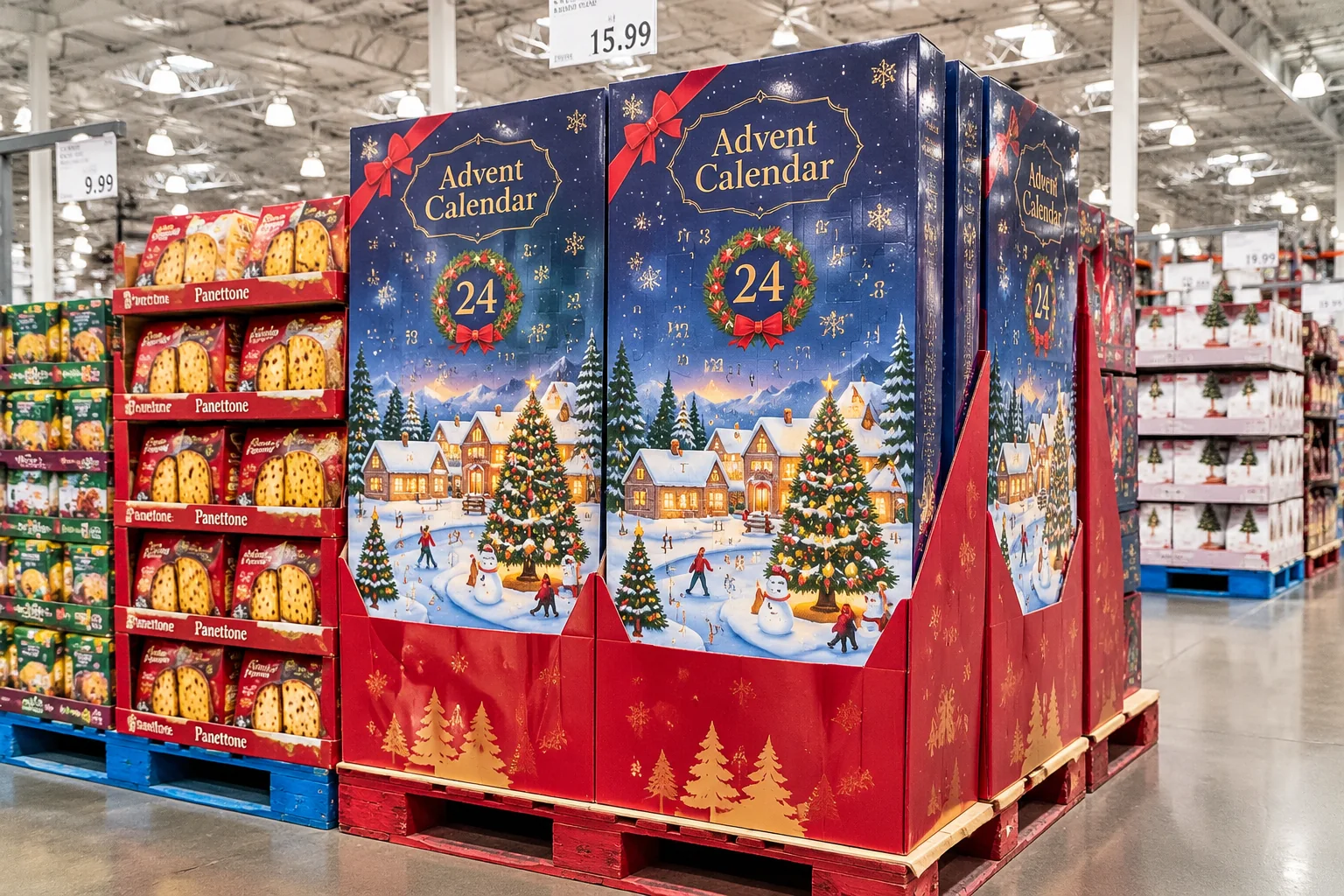
Can the packaging support retail display?
For supermarkets and chain stores, the packaging should be easy to handle, stock and present on shelves.
If the calendar is designed for display directly in stores, buyers can also consider PDQ display boxes or other retail-ready packaging solutions.
Can the packaging withstand transportation?
Heavy products, glass bottles and fragile items require appropriate internal protection and shipping carton specifications.
A packaging supplier should evaluate the complete packing configuration rather than only the individual advent calendar box.
Confirm the retailer’s receiving brief: shelf footprint and access, barcode location, assortment identification, master-carton quantity, pallet configuration and any retailer-specific packing instructions. Use the retailer’s supplied requirements and agree any validation before production.
9. Confirm Samples, Production Specifications and Quality Control
Before approving mass production, buyers should request a physical sample or an approved pre-production sample.
The sample should be evaluated for:
- Overall dimensions and structural stability.
- Opening and closing performance.
- Compartment dimensions and product fit.
- Printing colors and decorative finishes.
- Insert positioning and product protection.
- Assembly quality and visual consistency.
- Final packing and transportation suitability.
For supermarket chain orders, it is especially important to establish a clear specification sheet and approved sample as the reference for mass production.
Any changes to the structure, materials, printing or internal inserts should be confirmed before production begins.
This helps reduce misunderstandings between the buyer, packaging manufacturer and assembly team.
10. Choose a Packaging Supplier with Complete Project Capabilities
A suitable advent calendar box supplier should offer more than printing and box manufacturing.
For supermarket chains and large retail buyers, it is important to work with a partner who understands the complete packaging process.
When evaluating potential suppliers, consider:
- Experience in custom advent calendar packaging.
- Ability to develop different box structures.
- Material and printing knowledge.
- Custom internal insert development.
- Product compatibility and protection planning.
- Assembly and fulfillment capabilities.
- Quality control procedures.
- Export packing and transportation coordination.
- Communication and project management.
A supplier with packaging production and assembly capabilities can help coordinate different project stages and reduce the complexity of managing multiple suppliers.
11. A Practical Procurement Checklist for Supermarket Buyers
Before requesting a quotation for custom advent calendar boxes, prepare the following information:
| Brief item | Details to prepare |
|---|---|
| Product category | Beauty, food, tea, coffee, pet products or other planned contents. |
| Countdown and item count | 12-day calendar packaging, 24-day or another specified sequence; list the contents for each position. |
| Product dimensions | Length × width × height of each filled product, including caps and closures. |
| Product weight | Individual filled weight and the complete-set weight. |
| Primary packaging | Sealed bag, bottle, jar or carton; identify any intended direct contact. |
| Box structure | Door, drawer, book-style, individual inner boxes or another suitable structure. |
| Internal protection | Insert layout, support points, removal access and any fragility concerns. |
| Artwork and finishes | Print files, colour references and the finishes to be sampled. |
| Assembly scope | Empty box, box assembly, agreed product loading, labelling and final packing. |
| Destination and quantity | Order quantity, destination market and named receiving location. |
| Target dates | Sampling approval, component availability and required delivery dates. |
| Retail and carton requirements | Shelf footprint, barcode position, assortment identification, master carton and pallet requirements. |
The more complete the initial information, the easier it is for the supplier to recommend an appropriate structure, calculate costs and prepare an accurate quotation.
12. Work with a Packaging Partner for Your Next Advent Calendar Project
Developing a successful advent calendar for a supermarket chain requires coordination between packaging design, material selection, product compatibility, manufacturing, assembly and logistics.
Discuss your custom Advent calendar packaging brief with HC Packaging for your retail, brand or seasonal gift programme.
Use the product category, compartment count and filled-container sizes to compare suitable structures. The same seasonal programme may call for numbered doors, individual inner boxes, drawers or another agreed arrangement; the choice should follow the actual assortment and retail brief.
The manufacturing site, assembly scope and packing arrangements are confirmed for each project during quoting. Bring the product assortment and retail-distribution requirements into the discussion at the beginning.
Whether you are developing a new seasonal retail collection or sourcing customized advent calendar boxes for a supermarket chain, our team can help evaluate the packaging structure, internal inserts, material specifications and assembly requirements.
Planning your next seasonal retail program?
Contact HC Packaging to discuss your custom Advent calendar box requirements.
Frequently Asked Questions (FAQ)
1. What is the best advent calendar box structure for supermarket chains?
The best structure depends on the product category, retail price target, compartment requirements and display preferences. Drawer-style, door-style, book-style and folding advent calendar boxes are common options for supermarket seasonal collections.
2. Can custom advent calendar boxes be designed for 12 or 24 products?
Yes. Advent calendar boxes can be customized for 12, 24 or other quantities of compartments. The structure and internal layout can be developed according to the number, dimensions and weight of the products.
3. What materials are commonly used for custom advent calendar boxes?
Common materials include rigid greyboard wrapped with printed paper, folding carton paperboard, PET blister trays, paperboard inserts and foam inserts. The final selection depends on the required structure, product weight and protection needs.
4. Can advent calendar boxes be assembled before delivery?
Packaging may be supplied empty, pre-assembled or with product loading included where that service has been agreed. The suitable format, loading feasibility and responsibilities must be confirmed during quoting and project planning.
5. How should buyers choose the assembly location?
Compare product and component availability, the agreed loading scope, onward distribution and the target receiving date. Confirm which site will perform each step and who is responsible for product loading, inspection and final carton packing before approving production.
6. How can buyers reduce the cost of custom advent calendar boxes?
Buyers can optimize the box structure, material specifications, internal insert design, printing processes, assembly methods and transportation configuration. Evaluating the complete landed cost is more useful than comparing the outer box unit price alone.
7. Are custom advent calendar boxes suitable for food products?
Yes. They can be designed for products such as chocolates, tea, coffee and jam. However, the direct food-contact packaging must meet the applicable requirements of the destination market. The outer box and internal protective insert should not automatically be treated as food-contact materials.
8. What information is needed to request a quotation?
Buyers should provide the estimated order quantity, product dimensions and weight, product category, preferred box structure, internal insert requirements, assembly needs, destination market and target delivery schedule. Product samples or reference images are also helpful.